- Estrid’s refillable antiperspirant redefines sustainable rollerball deodorant by separating reusable parts from disposable ones
- The design uses a durable polycarbonate roller ball and a recyclable twist-in refill cartridge.
- Designed by Sample Studio, the project spans full industrial design execution, from early concept and functional 3D-printed prototypes to high-fidelity 3D renders created for product marketing.
This refillable rollerball deodorant system feels like such a smart, satisfying leap forward. It’s sleek, minimal, and genuinely beautiful without trying too hard. The brand is called Estrid, and Sample Studio is the design agency behind the packaging.
It’s refillable in a way that doesn’t feel over-engineered. The roller ball stays, while the recyclable cartridge twists in cleanly, separating what should be reused from what shouldn’t.

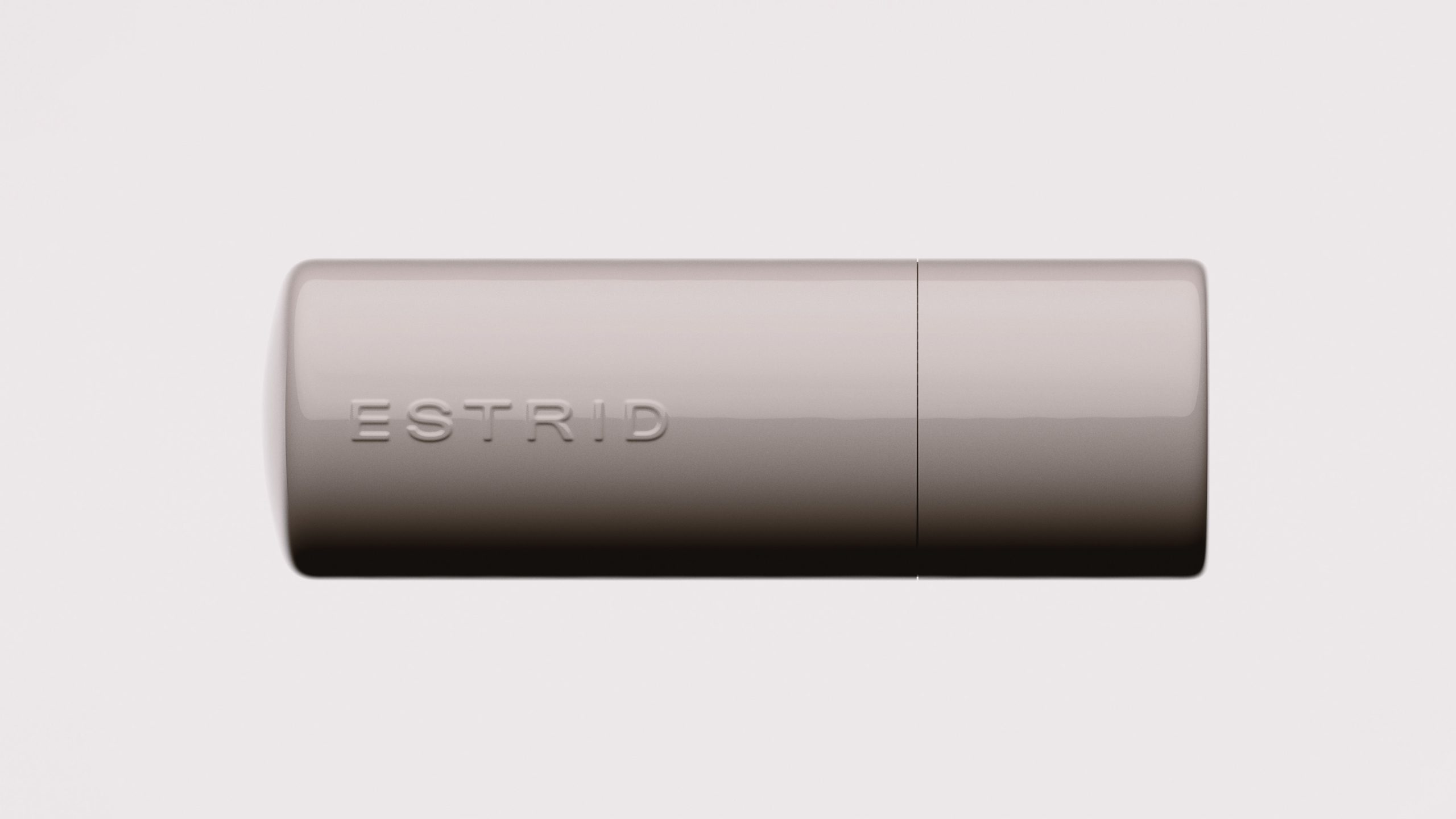
Visually, the simple cylindrical form and glossy finish make it feel more like something unearthed from the world of skincare rather than a utilitarian bathroom product (almost exactly what I mentioned in my recent Shelf Life about how the skincare market is coming for your armpits). The result is a system that’s sustainable but chic enough to leave out on the counter, a rare combo. You can see the industrial design thinking in every detail.
Tyler Anderson, Designer and Partner at Sample Studio, dives into the design process below.

What was the client’s brief for this project?
The brief was to design a refillable rollerball deodorant system, which, to our knowledge, had not been done before. Most rollerball deodorants combine the ball mechanism and the deodorant into a single disposable unit that gets thrown away once it’s empty.
The goal was to separate those components by creating a compact refill cartridge that could be efficiently shipped, while housing it in a premium, reusable outer shell. Deodorant was a new category for the brand, so the challenge was to rethink a very familiar product format through a more considered, refill-driven system.
Visually, the client wanted the product to feel at home in the beauty space rather than reading as a conventional or athletic deodorant. That drove a softer, cylindrical form with restrained detailing, allowing it to blend naturally alongside skincare and cosmetic products.
How did you execute the brief and what were some of the strategic design elements that you built into the brand?
Because the brand already existed, our focus was entirely on the product and system design. One of the first things we explored was the refill architecture itself. Early on, we assumed the refill would be serviced from the bottom, but through prototyping, we quickly realized that approach created a messy and frustrating user experience. That led us to prioritize the refill interaction before finalizing the form. A clean, intuitive refill experience became the foundation for the rest of the design.
One key design element that emerged from the exploration is how the product is stored. The deodorant is intentionally designed to rest on its lid and not easily stand on the refill end. Similar to storing a marker or pen tip down, this keeps the roller-ball in constant contact with the liquid formula, resulting in a more consistent application over time.

What was the most challenging part of the design process?
The most challenging part of the design process was developing a system that felt reliable without feeling over-engineered. Because the product uses a liquid formula and a refillable rollerball, everything needed to work together with very little margin for error.
The system had to perform consistently across everyday use, refilling, and situations like air travel, all while feeling seamless and intuitive. Balancing those requirements without adding unnecessary complexity was the core challenge, and one that required a lot of iteration to get right.

What is your favorite part of the final result?
My favorite part of the final result is how intuitive the overall product experience feels. From the beginning, the goal was for the system to make sense immediately and for the refill process to feel straightforward rather than cumbersome. There’s a clear separation between the interactions for everyday use and actions for refilling, which helps the product feel effortless in daily life.
More broadly, the hands-on nature of the process was a highlight. The mechanical requirements and form factor allowed us to quickly prototype, define the system hierarchy early, and dial things in without excessive back-and-forth.
We were also able to return to the project after completing the industrial and product design to execute the editorial 3D imagery. Having designed and prototyped the product ourselves meant we knew exactly which details and interactions to highlight, and that familiarity helped us create a more compelling image set. We’re really proud of how everything came together.
CASE STUDY
Estrid’s first refillable antiperspirant roll-on rethinks what sustainability can look like in the roller ball deodorant space. Instead of replacing the entire ball mechanism, the design separates the reusable components from the disposable ones – a durable polycarbonate roller ball pairs with a recyclable refill cartridge that twists into place. The result is a cleaner, more intentional approach to refillability.

A simple cylindrical body is finished with mirrored endcaps, encouraging the deodorant to stand upright with the ball facing down so that the tip is always ready to go, already primed with product. The threaded cap creates a sealed, leak-proof system that travels well, while the refill cartridge snaps in vertically, reinforcing the difference between opening and reloading.

Our team at Sample Studio led the industrial design, taking the product from early concept through final execution. This included functional 3D-printed prototypes and high-fidelity 3D visuals for marketing use.


Credits:
Industrial Design and 3D – Sample Studio
Lifestyle Photos – Estrid