
From Fossil Legacy to Renewable Future: Redefining Seafood Logistics
The Problem: An Industry Addicted to “Shipping Air” and Waste For over 50 years, the global seafood industry has relied on a single standard: Expanded Polystyrene (EPS) boxes. While functional, EPS is a fossil-based relic that creates massive ecological and economical inefficiencies. The design flaw of EPS is inherent in its structure: it is rigid and bulky. This forces logistics fleets to transport up to 50% “air” when moving empty packaging, leading to unnecessary CO2 emissions and wasted storage space. Furthermore, EPS disposal is a global challenge. Often contaminated and hard to recycle, it frequently ends up in incineration or landfill, representing a linear “take-make-waste” model that is incompatible with modern circular economy goals and tightening EU regulations (PPWR).
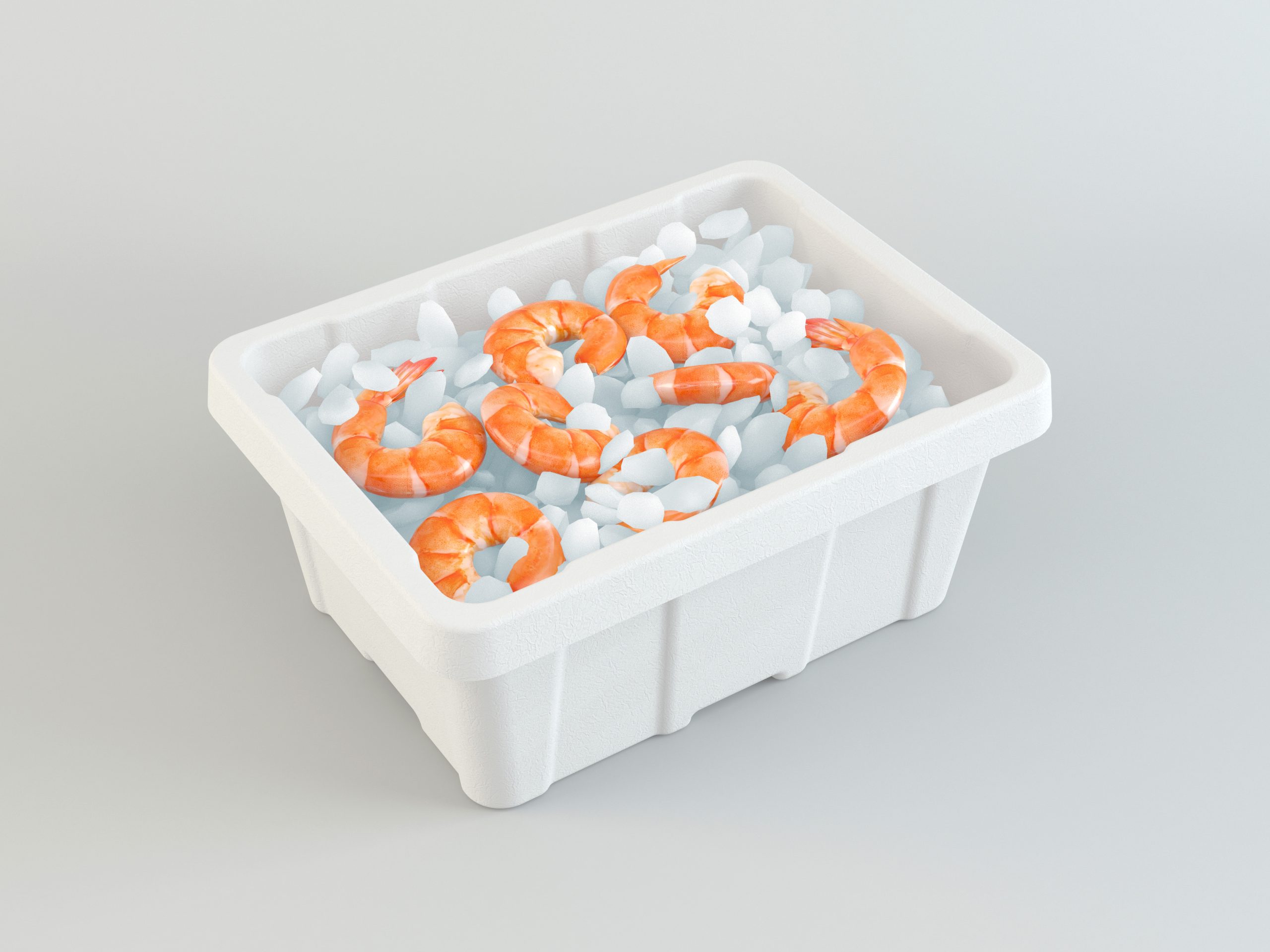
The Solution: The Fiber Box Developed by PAPACKS and currently deployed by a leading European seafood wholesaler, the Fiber Box is the first industrial-scale answer to the EPS problem. It is not just a box; it is a holistic system change. By replacing fossil-based plastic with renewable resources (fresh fiber and industrial hemp), we have created a transport solution that aligns ecological responsibility with logistical performance.

Design Innovation: Nestability (The TCO Game Changer) From a design perspective, the most significant breakthrough is the structural shift from “rigid bricks” (EPS) to a “nestable system” (Fiber Box). Unlike EPS, the Fiber Box features a tapered design that allows empty units to stack inside one another.
Logistical Impact: This nestability reduces the volume required for storage and return transport by approximately 50%.
Efficiency: Where a truck once carried 1,000 empty EPS boxes, it can now carry nearly 2,000 Fiber Boxes. This drastically cuts transport movements and associated carbon emissions before the box is even filled.
Material & Sourcing: The Power of Hemp The Fiber Box utilizes a unique material composition of fresh cellulose fibers and industrial hemp. Hemp was chosen for its rapid growth cycle, soil-regenerating properties, and exceptional fiber strength. This creates a robust matrix capable of withstanding the demanding conditions of cold-chain logistics. The material is sourced responsibly, moving the industry away from finite oil reserves toward renewable agriculture.
End-of-Life: Designed for the Paper Stream The core principle of the Fiber Box is circularity. While EPS often requires specialized, expensive separate collection streams, the Fiber Box is designed to integrate into the world’s most established recycling infrastructure: the paper stream. After use, the box can be disposed of in standard paper recycling (subject to local regulations for food-contact packaging cleanliness). This transforms a former “hazardous waste” cost center into a potential resource, closing the loop effectively.

Performance: No Compromise on Freshness Sustainability cannot come at the cost of food safety. Produced in Germany under strict BRCGS and ISO 9001 standards, the Fiber Box matches the performance benchmarks of traditional EPS:
Thermal Insulation: Extensive testing confirms the box maintains a core temperature of 0–1°C for up to 48 hours (at 5°C ambient temperature), ensuring the freshness of highly sensitive seafood.
Hygienic Barrier: A specialized, food-safe barrier coating prevents water penetration and ensures the box remains stable even when packed with wet ice. It eliminates the risk of “particle flight” (microplastic contamination) often associated with brittle EPS breakage.
Conclusion The Fiber Box is more than packaging; it is a statement. It proves that the seafood industry can decouple from fossil plastics without sacrificing quality. By combining renewable materials with smart, nestable design, PAPACKS has created a scalable solution that solves the waste problem of the past while meeting the regulatory and logistical demands of the future.

Sustainability Details
1. Material Substitution (Fossil vs. Renewable) The Fiber Box replaces Expanded Polystyrene (EPS) – a fossil-based plastic derived from crude oil – with renewable raw materials. The primary components are fresh cellulose fiber and industrial hemp.
Why Hemp? We utilize industrial hemp for its rapid growth cycle (up to 4 meters in 100 days), high CO2 sequestration during growth, and soil-regenerating properties. Its long, strong fibers provide the necessary structural integrity to replace rigid plastics.
2. Logistics Efficiency (The “Hidden” Emissions Saver) Sustainability extends beyond the material to the supply chain. The box features a nestable design (tapered shape), unlike the rigid “bricks” of traditional EPS packaging.
Impact: Empty Fiber Boxes require approximately 50% less storage and transport volume than EPS boxes. This effectively doubles the amount of packaging transported per truck, significantly reducing transport-related CO2 emissions before the box is even used.
3. Circular End-of-Life Strategy The design prioritizes established recycling infrastructure over theoretical compostability. The Fiber Box is engineered for the paper recycling stream.

The Benefit: While EPS often ends up in incineration due to complex recycling logistics, the Fiber Box can be reintroduced into the cycle as a raw material (subject to local regulations for food-contact packaging cleanliness), promoting a true circular economy.
4. Production Standards Manufactured in Germany, the production adheres to strict ISO 9001 and BRCGS standards. Regional production minimizes supply chain distances compared to imported alternatives.
5. Food Safety & Waste Reduction The box utilizes a FoodSafe functional barrier that prevents water and ice penetration while ensuring direct food contact safety. Unlike brittle EPS, which can break and contaminate fish with microplastic particles (“particle flight”), the fiber structure remains stable, reducing food waste caused by contamination.